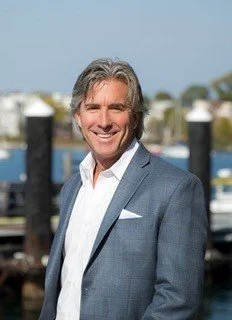
I Died for Six Minutes. Here's What I Came Back Knowing About Resilience.
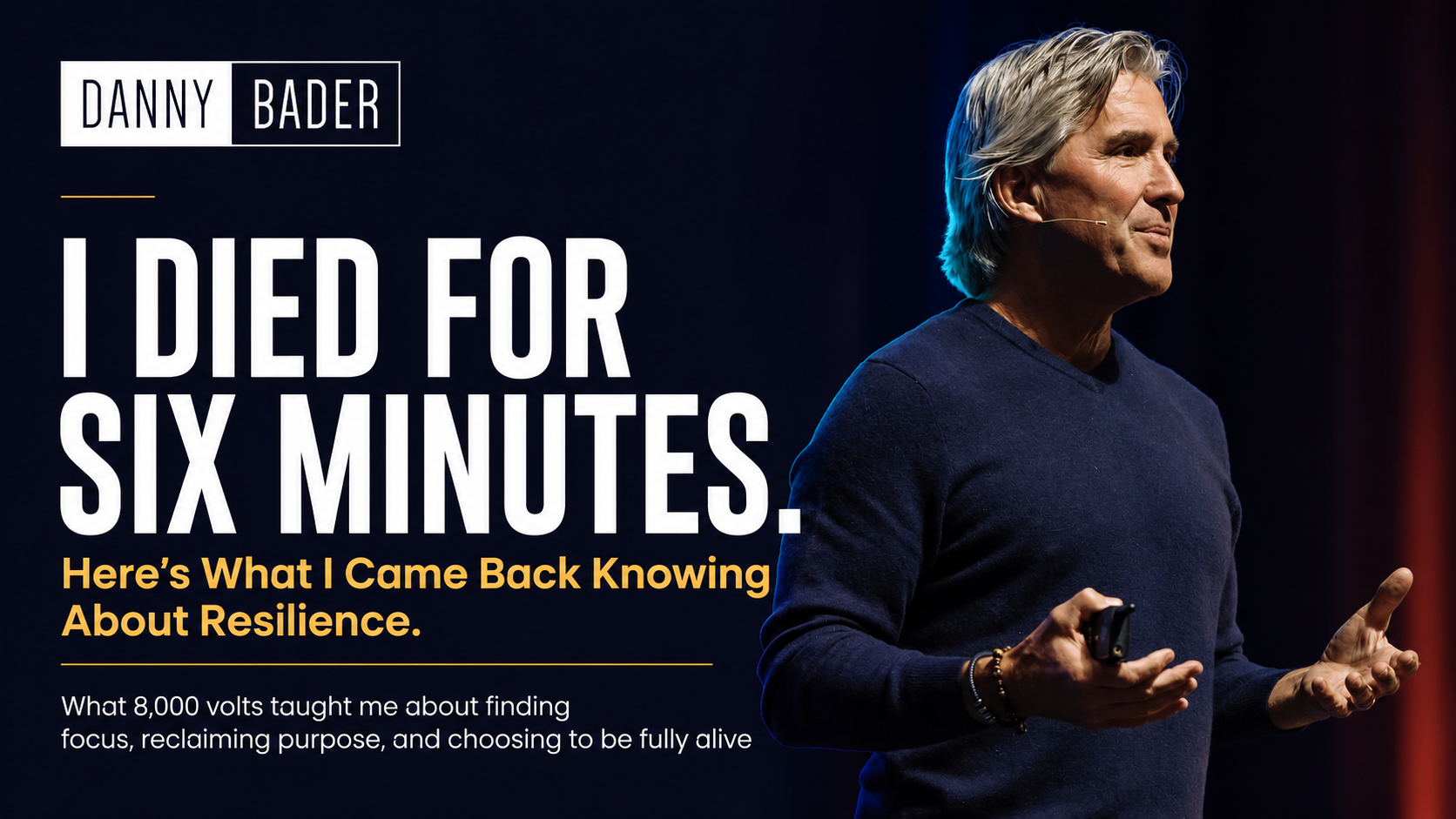
What 8,000 volts taught me about finding focus, reclaiming purpose, and choosing to be fully alive
Real resilience is not bouncing back. Bouncing back would mean returning unchanged — same person, same life, picking up where you left off. But you are never the same after you move through a difficult challenge. Resilience is not who you were before. It is who you become on the other side. I know this because I am Danny Bader, a motivational keynote speaker who survived 8,000 volts of electricity and six minutes of clinical death, and I cannot go back to who I was before. Neither can your people after the hard season they are moving through right now.
On July 28, 1992, an 8,000-volt electrical line killed me and my coworker Bruce on a job site. I came back after five or six minutes. Bruce, who was 37, did not.
This is the full story of what happened that day, the years I spent lost afterward, and the five principles that brought me back to life. If you are a leader trying to build resilience in your team, or a person trying to find your way out of a dark place, the same truth applies to both of you.
July 28, 1992
I was working for two brothers, Bruce and Stew, who ran a roofing company. At the end of the day, Bruce was getting ready to take his young son fishing. I was headed to tell my girlfriend I loved her before moving back to Aspen, Colorado, this time for good.
None of that happened. Bruce and I were lowering a metal ladder near the electric line that ran along the street. I asked him, are we clear? He said yes, we did it this way this morning. And I had that feeling in my gut, the kind you have probably had yourself, the voice that warns you a half second before your brain catches up. I did not pay attention.
We started to lower the ladder. Then we hit the line. About 8,000 volts came down the metal and went into both of us. In that instant, we both left this world.
Five or six minutes later, according to Stew, the other brother who came down off the roof and worked on us, I came back to life. Bruce did not. He was 37 years old. A beautiful man. A husband, a father, a son, a brother. Just a great guy.
When the paramedics moved us apart, I sat down against a fence and looked at my feet. I had holes in my work boots, one on each side. I took them off, and there were holes in my white socks. Then holes in each foot, two holes per foot. They were not bleeding, because the electricity had cauterized every blood vessel. I sat there staring into the holes in my own body, trying to understand what on earth was happening.
Stew told me the part I could not have known. He had come down the ladder and reached me first: eyes rolled back, foam at my mouth, no heart rate, no respiration. He worked on me with CPR for a couple of minutes, and it was not working. He gave me up for dead. He ran across the street for help, ran back past me, and that is when I crawled up next to Bruce and tried to breathe life back into my friend. I still remember the blank stare in his eyes and the feeling of his mustache on my lips.
Absolute Peace
Here is the part that changed everything I believe about being alive.
When the electricity hit me, there was no pain and there was no panic. There was absolute calm, peace, and love, and all these words that do not even do it justice. In that calm, I felt my life force, my soul, my spirit, pull away and leave my body. I was joined with something. I have my beliefs about what that was. I believe it was God.
I had a choice: stay or come back. And the honest truth is I did not necessarily want to come back. Then one thought surfaced — what about my mom, and Lisa? — and in that instant I was right back in my body, pins and needles, unable to move, hearing Stew twenty feet away trying to revive his brother.
That experience is the foundation of everything I teach. This life is not all there is. It is just all there is for us right now. When the body stops, there is a part of you that does not.
The Valley of the Victim
I was in the hospital for ten days. When I got out, I dropped straight into what I now call the Valley of the Victim.
The Valley of the Victim is where you do not own what is happening to you. There is no traction. There is no movement forward. It is blame, regret, and a dark disconnection from life, from the potential of life, from your own spirit. That is exactly where I lived. The story on a loop in my head was, why me and not Bruce? He was married with three kids. One was two months old.
The self-talk got darker. I screwed up. We should have stopped. Why didn't we stop? We saw the wires. I don't deserve to be happy. I tried to suppress all of it by drinking and numbing out. I was running from the struggle instead of moving through it, and I was shutting everyone out.
About three months after the accident, I went down to the Outer Banks of North Carolina. I was about as deep in that valley as a human being can get. I went there with the intention of not coming back. I am telling you that plainly because softening it would betray how real the bottom was, and because real resilience only means something if you are honest about how far down it starts.
The Phone Booth
One day in the Outer Banks, I walked into a hardware store, just looking at things to buy. I did not buy anything, because my angel showed up.
I believe in angels, maybe not the kind with wings and halos and swords, but people who cross your path exactly when you need someone to. She was about 80 years old, four and a half feet tall, with spiked white hair, suntanned skin, and a bright white smile sitting below piercing blue eyes. My beach-bum angel. She walked past my aisle and said something to me. I have no idea what it was. I never saw her again. But whatever she said disrupted the negative story running in my head.
Shaken, I did the next best thing, plan B, and went out and got drunk, which solved nothing. Walking back to my motel, I saw a phone booth at the edge of the parking lot, and I was drawn to it. I had not even noticed it when I arrived a few days earlier.
I went in and called my mom. She said, when are you coming home? We can't wait to see you. I had a lump in my throat the size of a softball. I told her I would be home in a few days. When I walked out of that phone booth, something shifted. The little voice in my head said, I wonder what it's going to be like when I get better.
That was the turning point. In the Valley of the Victim, you have no vision of getting through. For the first time, I had one. And the question I had been asking — why did I come back? — started to be replaced by a far better one: what am I going to do with it?
Purpose did not arrive as a lightning bolt of revelation. It arrived as a debt. I owed it to my friend Bruce to get better, to do my best to be a good man like he was, and to live a productive life of love toward other people. That is where it started. I had to honor the struggle and accept that I was in it, which is exactly the counterintuitive idea I write about in A Radical Reverence for Your Life, in a chapter called Embrace the Struggle.
The Back to Life Blueprint
The Back to Life Blueprint has five principles. When I wrote my first book, Back to Life, a novel about a young man named Jake who survives an electrical accident and is very much based on me, I asked myself what carried me through the hardest time of my life and the 33 years since. It came down to these five.
Develop Vision. Imagine what needs to be real before it is. That is what happened when I walked out of the phone booth and started seeing myself getting better. Things happen twice: first in your head, then in reality. Walt Disney died five years before Disney World opened. At the grand opening, someone told Roy Disney it was a shame Walt never got to see it. Roy smiled and said, he did see it. That's why it's here.
Know Yourself. This is two things. First, your values: what truly matters, and whether you are designing your life around living them. Second, watching your self-talk. I use the acronym HUT: Hold Useful Thoughts. Are the thoughts I am having right now useful? Useful thoughts do not change the brutal facts of your situation. They change how you engage with them, and that changes everything.
Seek Support. I needed to let some people in, because I had been shutting them all out. You cannot move through it alone, and trying to is its own kind of suffering.
Be Still. In a world that runs on noise, stillness is a beautiful and powerful strategy. I come down almost every day to a little park where the Cape May ferry crosses to Lewes, Delaware, just to disconnect and settle. It is often in the absence of sound that you hear the most, not with your ears, but deeper. That is where you connect with your 4th Energy. You have your heart, brain, and lungs that keep your body running, and then a fourth energy: your spirit. When that electricity blew out my feet, it also severed my connection with spirit. Walking out of that phone booth is when the connection started to repair. Your spirit is your innate, intangible energy, and it wants only what is best for you.
Evolve. Undergo continuous, gradual change and growth. You don't go through difficult times. You grow through them.
You can go deeper on all five inside the Back to Life Blueprint online course.
What Resilience Actually Means
Resilience is not about bouncing back. Bouncing back would be okay, here I am, that's how I was and now I'm back, I'm the same. But you're not. You are never the same when you move through a difficult challenge.
So the real question is not, did I bounce back? It is, who am I now that I was not before, because I moved through this? For me, the answer is a much greater reverence for life. A deeper appreciation for the people I love, and not taking them for granted. Not getting freaked out about the small stuff that does not really matter. And a strength in my faith. I always believed there was something after this life, and now I know it.
Here is where it matters for leaders. I do a lot of work with Marriott, Ritz-Carlton, Hyatt, and Westin, and the trap I see is leaders building resilience by staring only at the vision: get the numbers up, get the guest satisfaction score up, solve the distribution problem. Don't just focus on getting the numbers up. Focus on who all your people are becoming. How are they growing through this difficult challenge? As you continue to build their growth, all the numbers and all the other things take care of themselves.
That is the whole shift. Stop measuring the bounce. Start measuring the becoming.
Frequently Asked Questions
What does it feel like to have a near-death experience?
For me there was no pain and no panic, only absolute calm, peace, and love that words do not capture. I felt my spirit pull away from my body and join with something I believe was God, and I was given a choice to stay or come back. The thought of my mom brought me back into my body in an instant.
What is the Back to Life Blueprint?
The Back to Life Blueprint is my five-principle framework for moving through difficult times: Develop Vision, Know Yourself, Seek Support, Be Still, and Evolve. It came directly from the principles that carried me through the years after my electrical accident and the loss of my coworker Bruce. The framework is taught in my books and my online course.
What is real resilience, and why isn't it about bouncing back?
Real resilience is not returning to who you were, because that is impossible. You are never the same after a serious challenge. Resilience is who you become on the other side of it. For leaders, that means focusing less on getting the numbers back up and more on who their people are becoming as they grow through the hard thing.
You Don't Go Through Difficult Times. You Grow Through Them.
Resilience was never about getting back to who you were. It is about who you become because you refused to stay in the valley. That is the heart of the Back to Life Blueprint, and it is the difference between surviving a hard season and being changed for the better by it.
You don't go through difficult times. You grow through them.
Bring Danny to Your Next Event
Danny Bader delivers keynotes on resilience, purpose, and the human Spirit to corporate conferences, hospitality and safety events, association meetings, and leadership retreats. If your team is stuck in the Functional Fog, going through the motions without traction, the Back to Life Blueprint gives them the framework to shift from surviving to fully alive. Read more on the motivational keynote speaker page.