A Resilience Framework for Teams: The Three Levels Where Every Team Lives
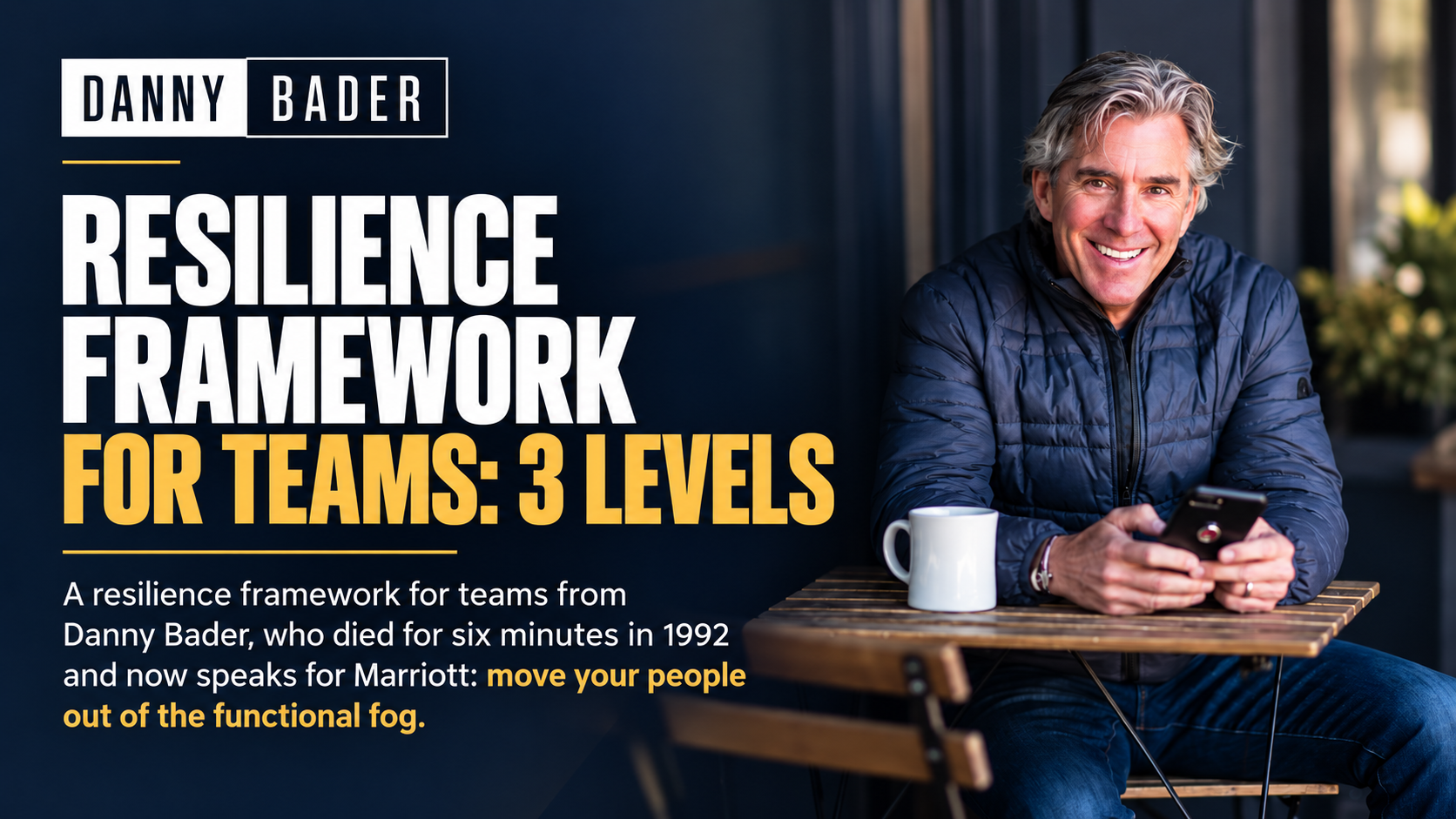
The team that should worry a leader most is not the one in crisis. It's the one that says it's doing fine.
What is a resilience framework for teams? It's a simple way to see where your people are really living, so you can help them move up. Mine has three levels: rock bottom, the functional fog, and a radical reverence for your life. Individuals, teams, and whole cultures all exist at one of them, and only the top level builds a real culture.
I'm Danny Bader. On July 28, 1992, 8,000 volts of electricity came down a metal ladder and went into me and my friend Bruce. Only I came back, after about six minutes. Since then I've spoken as a keynote speaker to teams at Marriott, Ritz-Carlton, Lincoln Financial, and Reebok, and these three levels are where I start.
The Three Levels: A Resilience Framework for Teams That Starts With One Person
Individuals, teams, and cultures can exist at three different levels, and it all starts with the individual.
Rock bottom is a place of disconnection from your spirit and from the gift of life. You're just stuck. I also call it the valley of the victim, where the whole mindset is "This is not fair."
Sometimes you land there by choice, sometimes by chance. After the accident, I signed a long-term lease there. I lost my faith, I wasn't letting my family help me, and I was drinking way too much. (More on what those six minutes taught me.)
In an organization, rock bottom shows up as blame, no accountability, and no forward energy. It's a toxic environment. It's okay to get there. It's not okay to stay there.
The functional fog is the middle. People are functioning and going through the motions. Days turn into weeks, weeks into years, and you look back and wonder where three or four years went.
A radical reverence for your life is the top. It's passion and purpose, fun, joy, laughter, and resilience. It isn't unicorns and rainbows. You can live there in the middle of tragedy, struggle, and setback.
Why the Functional Fog Is the Hardest Place to Build Resilience at Work
Most teams live in the middle level, and that's exactly what makes it dangerous.
When I run assessments in my workshops, usually 70 to 80 percent of people land in the functional fog. Research I cite puts it at 67 percent of employees, which I wrote about in the 67% problem.
Rock bottom is dark, and I'm not discounting that. But the one good thing about rock bottom is the huge opportunity for growth. The functional fog is just okay enough that there's no pressure to go to the next level. Nothing is on fire, so nothing changes.
What the functional fog is missing
People in the fog aren't empty. There's a little awareness and a little gratitude, just not enough to kick it to the next level. It gets drowned out by routine and the white noise of life. And without a vision, individually or as a team, you tend to drift.
How to tell which level your team is at
Listen to how people talk. These are the signals I describe from the stage:
"Living the dream." Ask someone in the fog how they're doing and you'll hear "living the dream" or "another day in paradise," dripping with sarcasm.
Showing up Monday, focused on Friday. You can't build a fully alive organization on that rhythm.
Blame instead of ownership. At rock bottom, nobody owns the struggle.
Time slipping by. Years pass, and nobody can say what the team created with them.
What a Team Living With a Radical Reverence for Your Life Looks Like
A team at the top level still has hard days. The difference is who owns them.
Can an entire organization live there at once? I don't think so. Life is too dynamic, and everybody is struggling with their own things.
What changes is ownership. At rock bottom, you experience a struggle and don't own it. At a radical reverence for your life, you say, "This is where we are right now, it sucks, and we will move through it."
I also ask what I call the sacred question: What will I create with the time that I have left? People say, you're a motivational speaker and you want me to think about dying? Don't fixate on it. Just contemplate it.
At rock bottom, nobody asks that question. At a radical reverence for your life, you're always answering it. A team asks it out loud: What will we create as a team, as a culture, as a company?
Can One Keynote Help a Team Build Resilience at Work?
A 45-minute keynote can move a room up these levels. It can't make them stay there.
I believe I can move people from rock bottom or the fog to a radical reverence for your life in 45 minutes. Will they stay there permanently? No. When they leave, they might slide back.
What shifts is awareness. When I hold up the mirror, it's very difficult for people not to find things they're thankful for, and to say, "We can move through this." Awareness precedes change and growth.
Then people ask how to get there. That's the Back to Life Blueprint: five principles, Vision, Know Yourself, Seek Support, Be Still, and Evolve, with no sequence and no hierarchy. Radical reverence is the philosophy. The Blueprint is what gets you there more often.
Frequently Asked Questions
What are the three levels of a resilience framework for teams?
In Danny Bader's framework, the levels are rock bottom, the functional fog, and a radical reverence for your life. Rock bottom is disconnection and a victim mindset. The functional fog is going through the motions. The top level is passion, purpose, and resilience, even in hard times.
Why do so many teams get stuck in the middle?
The functional fog is just okay enough that there's no pressure to move up. In Danny's workshop assessments, 70 to 80 percent of people usually land there.
Can a whole company live with a radical reverence for life?
Not everyone at once, in Danny's view, because life is too dynamic and people carry their own struggles. What a company can do is give people the framework, because awareness precedes change.
Does the effect of a resilience keynote wear off?
It can. People may slide back after a keynote, which is why the Back to Life Blueprint gives teams principles to practice so they return to the top level more often.
The Level Your Team Chooses
The middle is where most teams live, and it's the one level that never forces anyone to change. Awareness breaks the fog, and the Back to Life Blueprint keeps a team climbing. Life is too precious a gift to spend at rock bottom or in the functional fog. So ask your team: what will we create with the time we have left?
Bring the Three Levels to Your Next Conference
Danny Bader delivers this keynote at corporate conferences, leadership meetings, and association events. If your team is doing fine but not fully alive, this keynote shows them which level they're really living at and gives them five principles to move up.